LinkedIn social selling means becoming a familiar, useful name to a focused group of buyers before you ask them for anything. You keep a profile they trust, follow the people who feel the problem you solve, add insight to their conversations, and start a personal one when the timing is right.
Most explanations stop at the definition and a list of principles. The hard part is actually starting, alongside a full quota and a full calendar. So this page is a plan: four weeks, one focus per week, about half an hour a day. By the end you have a working routine instead of a good intention. When you reach week four, the free Personalization Tool helps you keep messages personal across a list.
How it differs from cold outreach
| Cold outreach | Social selling | |
|---|---|---|
| First contact | A message | A comment or a useful post |
| Timeline | Days | Weeks to months |
| What you lead with | Your offer | Their problem |
| Scale | Many people | A focused group |
These are not rivals. Social selling warms people up, so that when you do send a LinkedIn cold message, it is not really cold. LinkedIn describes social selling in four parts: establishing your professional brand, finding the right people, engaging with insights and building relationships. The four weeks below follow that order. LinkedIn’s Social Selling Index scores you on the same areas; treat it as a rough self-check, not a target. Our LinkedIn SSI guide explains the score.
Week 1: Rewrite your profile for a buyer
Buyers look at your profile before they reply to anything. Most sellers’ profiles are written for recruiters: title, company, years of quota attainment. A buyer does not care about any of that. They want to know whether you understand their problem.
Spend this week on four edits:
- Headline: who you help and what changes for them. “Helping support teams answer faster with better help centers” says more to a buyer than “Account Executive at Northwind.”
- About: the problem your buyers have, how you think about it, and what a conversation with you looks like. Write it so a buyer finishes it thinking “this person gets it.”
- Featured: one or two items that prove you know the subject, such as a short guide, a talk or a write-up of a customer problem you solved, shared with permission.
- Activity: your posts and comments appear on your profile. From now on, they are part of the pitch.
End of week check: show the top of your profile to a colleague and ask who it is for. If they say “recruiters,” keep editing. Our profile guides cover each section in detail.
Week 2: Build a list you can actually keep up with
Choose a focused group of accounts. Small enough that you can follow every person on it, for example 30 people across 10 companies. For each account, find the person who feels the problem and the person who decides, and follow both.
Then start a simple list, one line per person:
| Name | Company | Role | Signal | One real detail |
|---|---|---|---|---|
| Priya | Lumen Health | Head of Support | Posted about onboarding | Asked how teams document first-week questions |
The last column is the important one. It is the personal part of any message you send later. Signals to watch for include a new role or promotion, a hiring post on the team you serve, a post about a problem you solve, and company news such as a launch or expansion.
End of week check: every row has a real detail. A row without one is a person you do not know enough about yet.
Week 3: Comment with insight, and post once
This is the week people skip, and it is the one that makes the rest work. Spend ten minutes a day commenting on posts from people on your list. A good comment adds something: a related experience, a useful question, a resource, a respectful disagreement. “Great post!” adds nothing, and nobody remembers who wrote it.
An example, on a post about support team growth:
We saw the same thing with a team that doubled in a quarter. What helped most was writing down the 20 most common answers before the new reps started. Did you do anything like that?
That comment shares a lesson, stays on their topic and ends with a question that invites a reply. Our LinkedIn commenting strategy guide goes deeper on who to comment on and when.
Also write one post this week. Pick a topic your buyers care about and write from experience: a mistake you see often, a simple way to think about a common problem, a lesson from customer work. Not a product announcement. The Post Generator can turn a rough idea into a first draft, which you then rewrite in your own voice.
End of week check: a few people on your list have seen your name more than once, in a way that was useful to them.
Week 4: Turn familiarity into conversations
Now you have reasons to reach out that are not cold. Someone replied to your comment. Someone viewed your profile after your post. Someone on your list posted about the exact problem you solve. Each of those is a natural moment to connect or message, and the message should name the shared context.
Hi Priya, thanks for the reply on your onboarding post. Your point about first-week questions stuck with me. I put together a short list of what similar teams documented first. Want me to send it?
There is no pitch in that message, on purpose. The goal of the first message is a conversation. Ask about their situation, listen, and suggest a call only when it would clearly help them.
Keeping it personal across a list
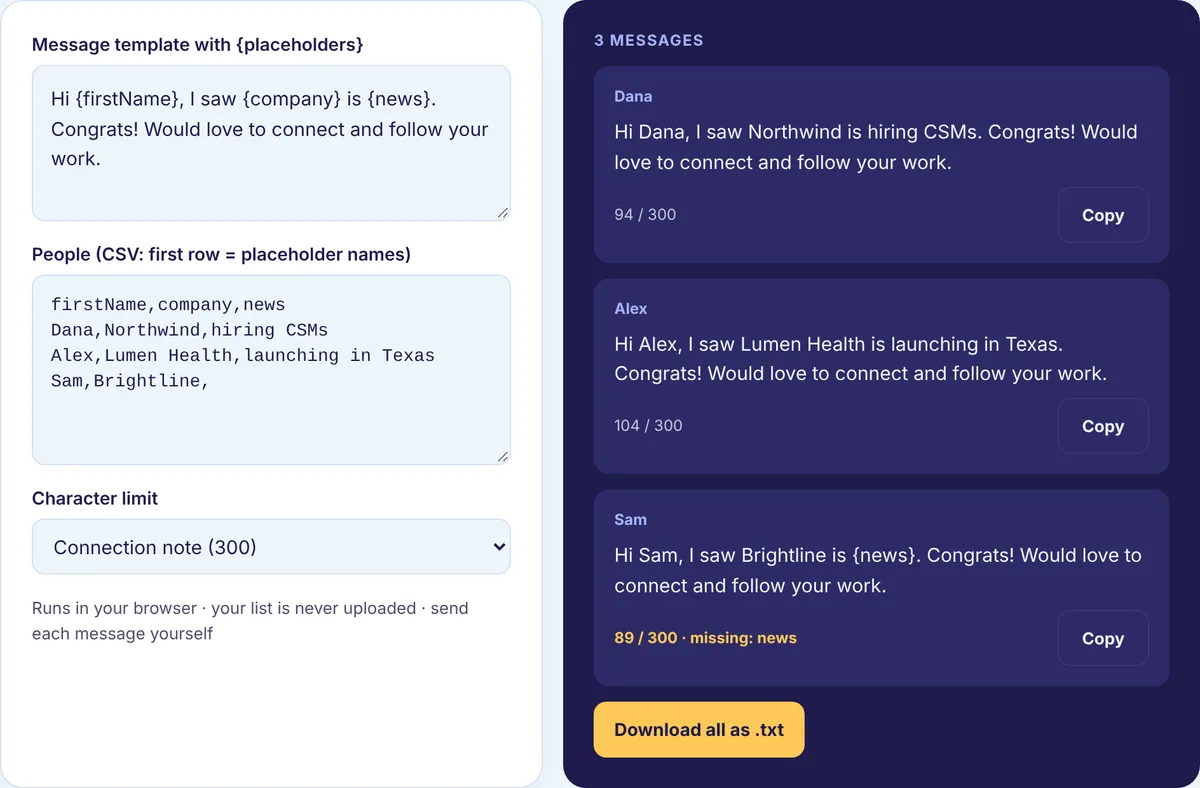
Social selling falls apart when people try to speed it up by sending one message to everyone. The fix is to separate the structure from the detail. Write one good message shape, then fill in the real detail from your week 2 list for each person.
The Personalization Tool does exactly that. You write a template with fields for name, company and the detail, paste your list, and get one message per person. It flags anyone missing a detail or running too long, so nothing goes out half filled, and you send each message yourself.
End of week check: you have had a few real conversations that did not start with a pitch.
After week 4: the half-hour routine
From here on, the plan becomes a daily habit of about 30 minutes:
- Read for ten minutes. Check your feed and your list for new posts and signals.
- Comment for ten minutes. A few thoughtful comments on posts from people on your list.
- Reach out for ten minutes. Connect with or message the people who showed a signal or engaged with you.
Once or twice a week, publish a post on one of your topics. Once a week, update the list: add people, retire accounts that went nowhere, and refresh the detail column.
How to tell if it is working
Track what feeds your pipeline, not likes. Each week, count conversations started, conversations that became meetings, and meetings that became opportunities. When a deal closes, note whether the buyer first saw you through a post or comment.
The single most useful question is one you ask new customers: “How did you first come across us?” It tells you more than any score. Compare month to month against your own numbers, because general benchmarks rarely match your market.
Things that undo the work
Pitching in the first message throws away the trust from weeks one to three. Commenting only to be seen is easy to spot and quickly ignored. Posting about your product every time turns your profile into an ad. Engagement pods and automation tools are against LinkedIn’s rules, and pods bring empty engagement from people who will never buy. And giving up after two weeks is the most common failure of all, because this approach builds slowly.
Start week 1 today
Open your profile and rewrite the headline for a buyer. Then, when you reach week four, write one template and let the free Personalization Tool fill in each person’s detail for you to check and send. For the wider outreach process, see our LinkedIn outreach guides.